

Berlin Startup Sends Satellite to Deep Space
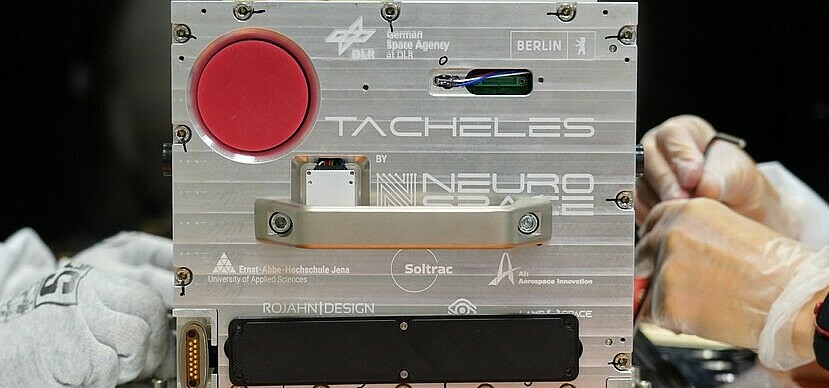
The construction of the Tacheles microsatellite in a cleanroom
A Berlin-built microsatellite is now cruising through deep space, and it could put a rover on the Moon within two years. That's the ambition behind Tacheles, a 20 x 20 x 30 cm satellite developed by Berlin startup Neurospace and successfully deployed on April 2 as part of NASA's Artemis 2 lunar mission, at roughly 40,000 kilometers from Earth.
The mission's primary goal is to test electronics intended for a future lunar rover, specifically how well they hold up against cosmic radiation in deep space. According to a press release from TU Berlin, the satellite carries sensors that can detect dangerously high radiation levels and shut down onboard electronics to protect them.
Neurospace was founded six years ago by Irene Selvanathan, a TU Berlin electrical engineering graduate. The startup works closely with TU Berlin's Chair of Space Technology and its Institute of Machine Tools and Factory Management. The bigger vision: deploying entire swarms of small, affordable autonomous rovers on the Moon to support science, industry, and the eventual setup of a lunar base.
Tacheles was built in a cleanroom in Berlin Mitte at a total cost of 1.8 million euros, with 1.3 million euros funded by the German Aerospace Centre (DLR). Three satellites from South Korea, Saudi Arabia, and Argentina were launched alongside it, all responding to the same NASA CubeSat call for proposals.
The team is now analyzing incoming data. If results are positive, a lunar landing could happen as soon as 2027.