

Berlin lab turns smartphones into water safety tools
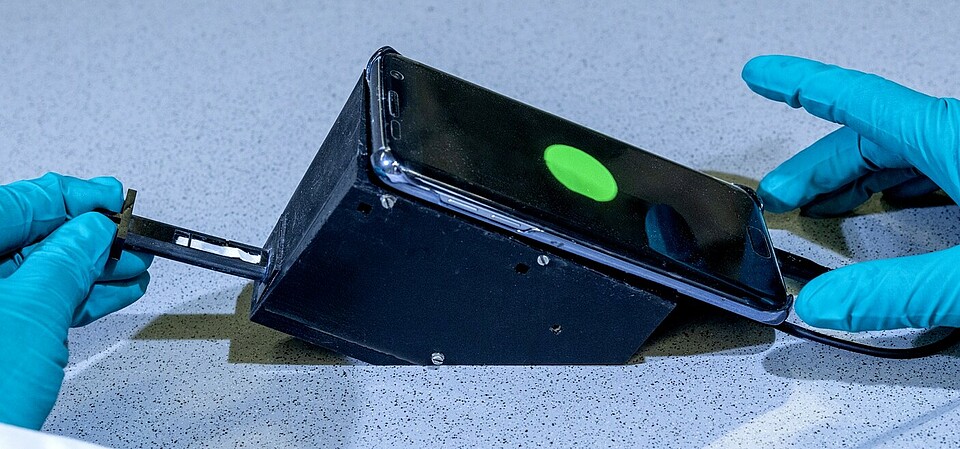
A smartphone camera measures the glow of the test strip in the portable measuring device, enabling a quick and straightforward analysis of water quality. © BAM
Clean drinking water is still far from guaranteed for billions of people around the world. Conventional lab tests can take up to 24 hours, require specialist equipment, and simply are not feasible in remote or crisis-hit areas. Researchers at the Federal Institute for Materials Research and Testing (BAM) in Berlin have developed a portable rapid test that changes this picture dramatically, according to a press release from BAM.
The test detects urobilin, a molecule produced when the body breaks down hemoglobin. Since it is excreted by all mammals, its presence in water signals fecal contamination. The BAM team engineered a highly sensitive strip that reacts to even trace amounts of urobilin and lights up on contact. The entire analysis takes less than a minute and requires just a single drop of water.
What makes this especially practical is how the test is read: a small LED powered by the smartphone illuminates the test strip inside a compact 3D-printed attachment, and the phone's camera measures the luminescence. No additional chemicals or laboratory infrastructure needed.
The system was validated using real water samples from Berlin rivers and a local wastewater treatment plant, where it reliably detected urobilin even in the presence of natural interfering substances. Developed by Marie Curie Fellow Swayam Prakash alongside sensing expert Knut Rurack, the technology is built for field use in developing regions, flood zones, and mobile monitoring programs.
BAM sees strong commercial potential for companies in environmental analytics, mobile diagnostics, and smart monitoring, making this a promising area for Berlin's growing cleantech and health-tech sectors.