
Berlin's New Battery Lab Targets Sodium-Ion Tech
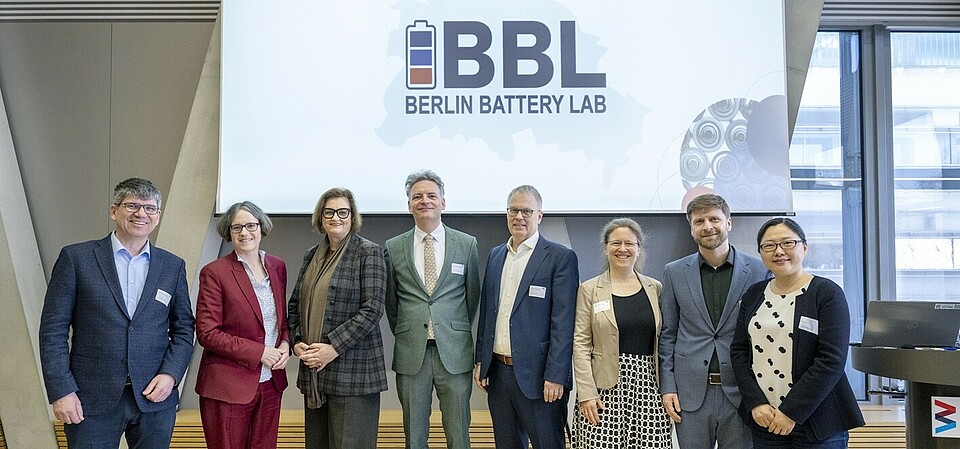
Prof. Bernd Rech, Prof. Julia von Blumenthal, Dr. Ina Czyborra, Prof. Philipp Adelhelm, Prof. Ulrich Panne, Saskia Vormfelde, Dr. Tim Fellinger, Prof. Yan Lu. © BAM
Berlin has a new weapon in the global race for better batteries. On March 19, 2026, three of the city's leading research institutions officially launched the Berlin Battery Lab (BBL): the Federal Institute for Materials Research and Testing (BAM), Helmholtz Zentrum Berlin (HZB), and Humboldt-Universität zu Berlin (HU).
According to BAM's press release, the lab focuses on sodium-based battery systems as a more sustainable alternative to conventional lithium-ion technology. The three partners bring distinct strengths to the table: BAM covers battery safety and materials, HU leads in sodium-ion research, and HZB brings lithium-sulfur expertise plus access to BESSY II, one of the world's most powerful X-ray sources for analyzing battery chemistry.
What makes the BBL stand out is its full-chain approach. Fundamental research, materials development, cell design, and safety testing all happen under one roof, which is designed to speed up the path from lab to market. The platform is explicitly open to external partners, making it particularly attractive for startups and tech-driven companies.
Berlin Senator Dr. Ina Czyborra confirmed that the State of Berlin is backing the initiative with €2.4 million from the European Regional Development Fund between 2026 and 2028.
BAM President Prof. Dr. Ulrich Panne put it plainly: new battery technologies are being developed in Germany, but they are not reaching application fast enough. The BBL is built to change that.
With this launch, Berlin cements its position as a serious hub for battery innovation in Europe.