ASCEND: €30M to Fast-Track Green Chemistry with AI
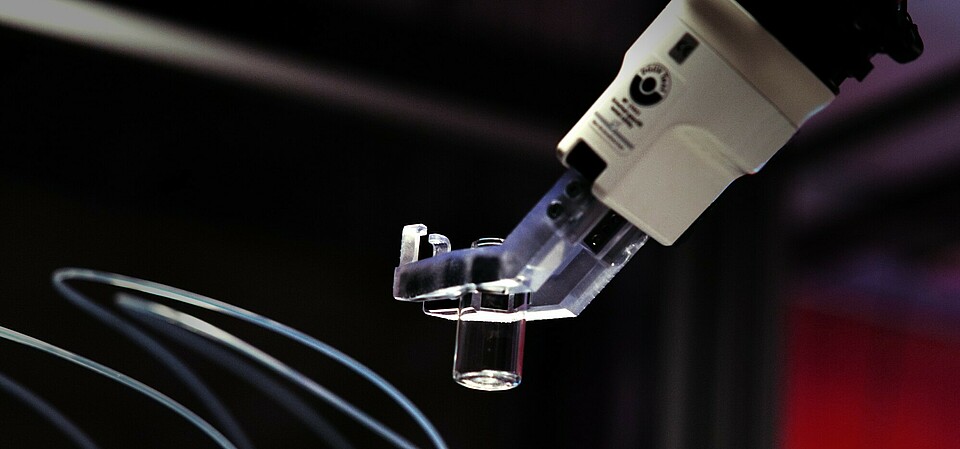
A robotic arm precisely moves an empty sample container back and forth between automated workstations. © Dunia Innovations
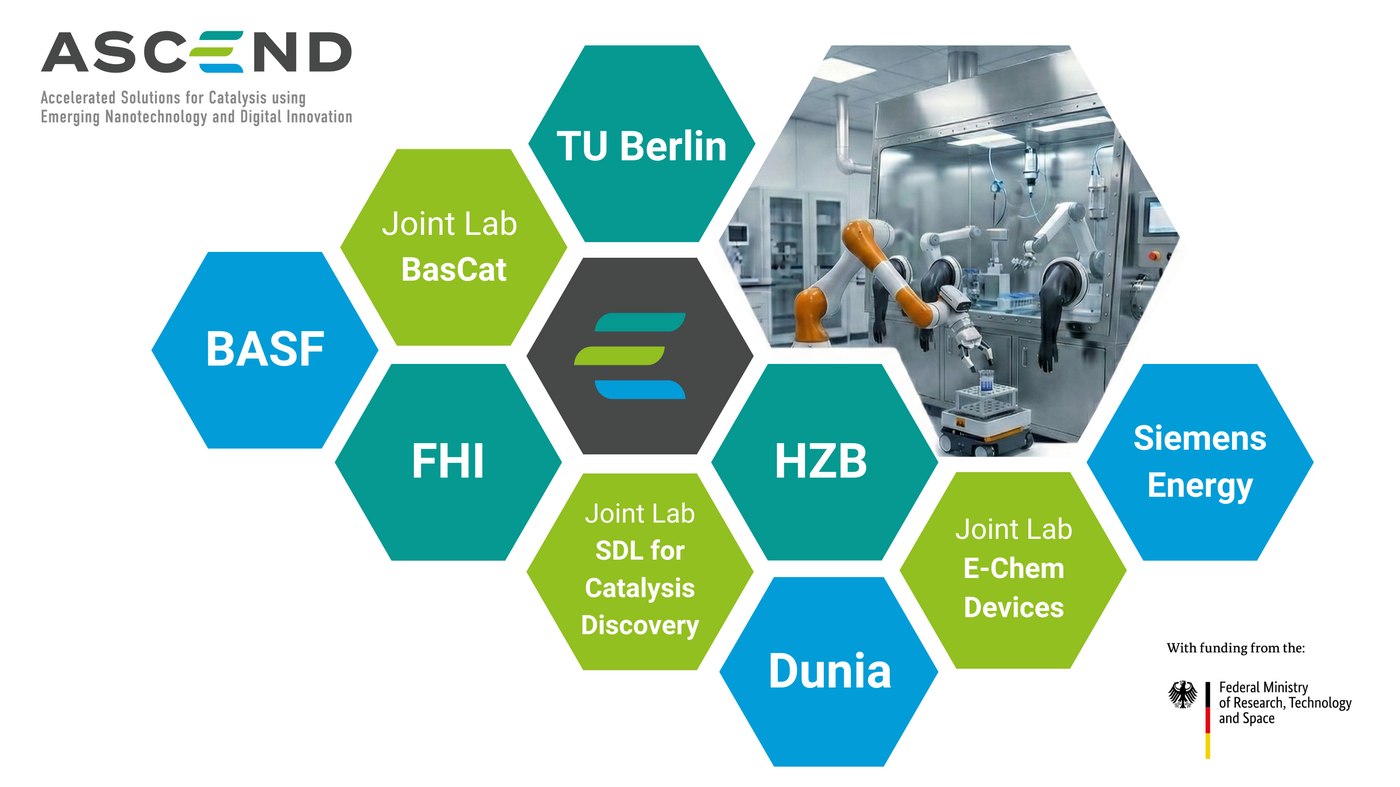
Berlin is becoming a hub for AI-powered green chemistry. Six partners from research and industry have joined forces under the banner of ASCEND (Accelerated Solutions for Catalysis using Emerging Nanotechnology and Digital Innovation), backed by €30 million from Germany's Federal Ministry for Science, Technology and Space. According to a press release from Helmholtz-Zentrum Berlin, the five-year project kicks off on April 1, 2026.
The consortium brings together Helmholtz-Zentrum Berlin (HZB), the Fritz-Haber-Institute of the Max Planck Society (FHI), BASF, Dunia Innovations, Siemens Energy, and TU Berlin. Five of the six partners are based in Berlin, making the capital a clear center of gravity for this initiative,
The goal? Speed up the discovery of next-generation catalysts using AI, robotics, and so-called self-driving laboratories (SDLs). These automated systems run experiments in iterative loops, with AI building and refining digital twins to guide each next step. Humans stay in the loop to define scientific direction, but the pace of discovery accelerates dramatically.
Why catalysts? Around 80% of all chemical products involve a catalytic step in production. The chemical industry accounts for roughly 6% of global greenhouse gas emissions, comparable to the entire European Union's annual output. Better catalysts could be the key to sustainable fuels and base chemicals that replace fossil-derived inputs.
"The AI-driven approach of ASCEND allows us to explore vast material spaces that were previously inaccessible," says project leader Karsten Reuter of FHI. His co-lead Michelle Browne from HZB adds that it fundamentally changes the speed at which science can deliver solutions the chemical industry urgently needs.