


Deep Tech Agenda: Berlin's ten-year innovation blueprint
More spin-offs, faster transfer pathways, better scaling conditions: what the new agenda means in practice for investors and companies.
Berlin has just made a strategic move: the Berlin Senate has unveiled the Deep Tech Berlin Agenda (DTBA), a comprehensive innovation program designed to turn the German capital into Europe's leading deep tech metropolis over the next ten years. The agenda was developed across government departments by Berlin's economics and science administrations, together with representatives from business, research and civil society. Its guiding principle: "Pioneering Tech for Freedom" – technological self-determination as a foundation for prosperity, resilience and competitiveness.
For internationally operating companies, investors and innovation actors who are weighing Berlin as a location for investment, market entry or collaborative projects, the document provides clear orientation. It does not merely describe where Berlin stands today – it maps out where the city is deliberately heading.
A strong starting position
Berlin's innovation profile is already remarkable. The city ranks among the most innovative five per cent of regions across Europe according to the EU's Regional Innovation Scoreboard. The underlying numbers speak for themselves: four universities, 39 higher education institutions and over 70 non-university research centres form one of the densest scientific landscapes on the continent. The Charité is considered Europe's leading university hospital. Over the past decade, more than 4,000 startups have been founded in Berlin, accounting for roughly 20 per cent of all new company formations in Germany. In 2024 alone, €2.1 billion in venture capital flowed into the Berlin startup scene – close to 30 per cent of all German VC investment.
Particularly striking is the ecosystem's international character: 42 per cent of employees in Berlin startups come from abroad, and English is the primary working language at half of all Berlin-based startups. This openness makes Berlin one of the most accessible innovation locations in Europe for international talent and companies alike.
Five technology fields, ten strategic levers
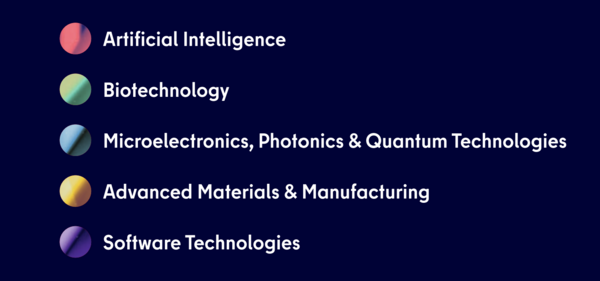
The agenda concentrates on five strategic technology fields in which Berlin already has proven strengths and sees especially high growth potential: Artificial Intelligence, Biotechnology, Microelectronics, Photonics & Quantum Technologies, Advanced Materials & Manufacturing, and Software Technologies.
These fields are not an arbitrary portfolio. They connect with Berlin's strongest application areas to form innovation ecosystems: AI intersects with healthcare, FinTech, mobility and CleanTech. Biotechnology links with health and sustainable manufacturing. Photonics and microelectronics provide the hardware foundation for aerospace, energy and defence technologies. Every technology field thus simultaneously addresses several of the most pressing economic policy challenges of our time.
Alongside this thematic prioritization, the agenda defines ten strategic levers to close structural gaps in the innovation process. These include accelerating knowledge and technology transfer via a dedicated "Transfer Bridge" connecting science and economic policy; expanding real-world testing environments (Reallabore) for live pilot conditions; improving access to growth capital; and repositioning public administration explicitly as an enabler of innovation rather than a bureaucratic obstacle. Berlin's international visibility as a deep tech location is also to be strengthened in a targeted way.
Three strategic goals
The agenda pursues three overarching objectives. First, Berlin aims to close a research gap: more private and public investment in research and development is intended to ensure that scientific excellence translates into market-ready products more quickly. Second, Berlin wants to overcome a transfer gap: through more spin-offs, more reliable transfer pathways and closer cooperation between universities and companies, the time from research to first commercial application is to be significantly reduced. Third, the agenda addresses a scaling gap: growing deep tech companies should find it easier in Berlin to access capital, skilled talent, test infrastructure and lead markets.
What this means for investors and companies considering Berlin
For internationally operating companies looking for a European location for research, development or market entry, the DTBA sends clear signals: Berlin is investing systematically in the structures that deep tech innovations need from the laboratory bench to scaling. In concrete terms, this means better access to public procurement as a first market, interoperable data spaces for AI and health applications, urban-embedded test environments, and an administration that explicitly commits to acting as an enabler rather than a barrier.
For investors, it is particularly relevant that the agenda is not static but designed as a learning strategy with continuous monitoring. The technology portfolios will be reviewed and adjusted in regular cycles. This creates planning certainty without rigidity – a signal that carries considerable weight given the pace of change in fields such as generative AI or quantum computing.
Alignment with European and national innovation policy
The DTBA is not an isolated state programme. It is explicitly aligned with Germany's Hightech Agenda Deutschland at federal level and with the European Commission's Competitiveness Compass. Berlin intends to contribute to national and European technological sovereignty while improving Berlin-based actors' access to Horizon Europe, the European Innovation Council and other EU funding instruments. The close economic ties with the neighbouring state of Brandenburg remain an important regional anchor – the joint innovation strategy innoBB is being updated in parallel.
Mayor and Senator for Economics Franziska Giffey has described the agenda as a "call to joint action" – directed at researchers, companies, public administration and civil society. The message is clear: Berlin does not want to be a passive recipient of global technology trends but an active shaper of them, and invites all stakeholders to join in.
The full Deep Tech Berlin Agenda, available in German, sets out the strategic framework, key areas of action and concrete guidance for everyone who wants to actively help shape Berlin's deep tech future.
Download
The complete Deep Tech Berlin Agenda in German is available for download here:
Deep Tech Berlin Agenda (PDF, German)

Header image: Berlin Partner/Wüstenhagen