



Berlin: Europe's Rising Hub for New Space Innovation
Germany is committing €35 billion to space-related defense through 2030. Berlin is positioning itself as the continent's most dynamic address for satellite technology. The door is wide open for international companies.
Something remarkable is happening in a cluster of labs, workshops and startups scattered across Berlin. In converted factory floors in Adlershof, in university spin-offs along the Spree, and in glass towers on the Kurfürstendamm, engineers and entrepreneurs are building the infrastructure for Europe's next generation of space capabilities, satellite by satellite, algorithm by algorithm.
Germany has always been serious about technology. But now it is getting serious about space, too, and in a big way. In September 2025, German Defense Minister Boris Pistorius announced that Germany will invest approximately €35 billion in space-related defense projects through 2030. At the ESA Ministerial Conference the same year, Germany reaffirmed its status as ESA's largest contributor, committing around €5.4 billion (roughly 23% of the total). These are not incremental budgets. They represent a strategic bet on sovereign, resilient, space-based capabilities at a moment when Europe can no longer afford to rely on others for access to critical satellite data.
Berlin, Germany's capital and startup capital, has emerged as the country's focal point for this ambition. More than 80 companies and research institutes in the Berlin-Brandenburg region are active in the space sector today. Their collective focus covers small- and nanosatellites, photonics, sensors, AI-powered Earth observation, and agile mission operations, which maps almost perfectly onto the technologies that will define Europe's New Space era. For international companies looking to enter or scale in the European market, that alignment is worth paying attention to.
A New Space Ecosystem Built for Speed
The global market for satellites in low Earth orbit is growing at a pace that would have seemed implausible a decade ago: from around $6.9 billion in 2025 to an estimated $36 billion by 2035. Falling launch costs, down roughly 90% over the past 30 years, have made it economically viable to deploy large constellations of small, affordable satellites. The number of operational satellites has tripled since 2020, and entirely new business models are emerging around the data they generate.
Berlin's space scene was shaped, from the very beginning, around exactly this kind of satellite. Several companies in the region manufacture small satellites, for example: Berlin Space Technologies (BST), Endurosat, Planet Labs Germany, Reflex Aerospace, Rapid Cubes, German Orbital Systems, and TU Berlin. Their expertise spans the full value chain: attitude control, propulsion systems, optical payloads, structural components, power supply, communications technology, and simulation software. This breadth, concentrated in one ecosystem, gives Berlin a structural advantage in markets where speed and integration matter most.
---
"We are now creating the industrial base that Europe has lacked so far. The ability for series production did not exist in Germany before – unlike in the US or even France."
Tom Segert, CEO of Berlin Space Technologies
---
Beyond hardware, Berlin has developed strong niches in downstream applications and AI-driven data analytics.
For international companies, this ecosystem offers something genuinely valuable: a dense network of specialized partners that can accelerate product development and enable a pace of innovation that would be hard to replicate elsewhere. Whether you are looking to co-develop a subsystem, validate a new payload, or build a constellation around European anchor demand, Berlin offers ready-made collaboration opportunities at every step.
Research Strength and a Deep Talent Pool
Space engineering is a field where the quality of your talent determines everything. Here, Berlin has a structural advantage that is difficult to overstate. The Technische Universität Berlin established Germany's first Chair of Space Technology in 1963, the oldest in the country, and today holds the extraordinary distinction of being the university with the most satellites in orbit of any institution in Europe. More than 30 TU Berlin satellites are currently circling the Earth, more than all other German universities combined. The university's Chair of Space Technology has trained generations of engineers who now populate companies throughout the Berlin ecosystem.
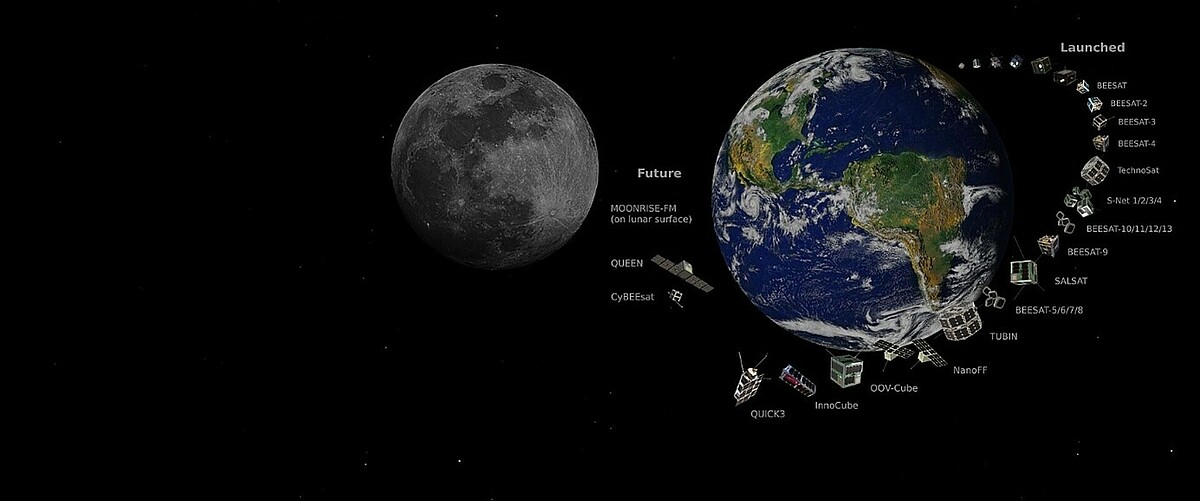
TU Berlin is not alone. The German Aerospace Center (DLR) operates a major presence in Berlin-Adlershof, and in May 2025 launched its new Institute for Space Research, a world-class competence centre for optical sensor systems, Earth observation, planetary research and security applications. The Fraunhofer Institutes in Berlin also take on R&D contracts from regional industry, ensuring that scientific advances translate quickly into commercial applications. Charité – Universitätsmedizin Berlin contributes space medicine research through its Centre for Space Medicine, and Freie Universität Berlin covers planetary sciences and remote sensing. Berlin is a city where academic depth and commercial energy reinforce each other.
This research base feeds a steady pipeline of engineering, IT and R&D talent into the local industry. Berlin's cosmopolitan character and relatively affordable cost of living attract skilled professionals from across Europe and beyond. The city's established startup culture, with its abundance of incubators, accelerators and co-working spaces, ensures that talented people find environments where they can work on genuinely ambitious problems.
Location Advantages: EU Access, Funding, and Stability
Setting up in Berlin means operating at the heart of the European Union’s single market, with direct access to the fastest-growing B2B and B2G space markets in the world. European governments, defense agencies, infrastructure operators and commercial players are all scaling up their demand for satellite-based services, and being located inside the EU’s regulatory framework gives companies a decisive edge in winning those contracts. Seamless cross-border trade, legal certainty and regulatory stability lower the cost and risk of doing business across the continent. EU funding programs, including Horizon Europe and the European Defense Fund, offer significant co-financing opportunities for space technology R&D and industrial partnerships.
Germany’s policy environment has shifted decisively in favour of the space sector. The federal government’s €35 billion commitment to space defense signals a new era of anchor procurement that benefits the whole ecosystem. The EU’s forthcoming European Space Shield Initiative, planned for launch in 2026, will add further demand for sovereign European capabilities. For companies entering now, the market ramp-up is already underway.
Berlin Partner for Business and Technology provides dedicated support for companies looking to establish or expand operations in the city, from initial market scoping through to introductions to potential partners, investors and public-sector clients. The support is practical, free of charge, and designed to help international companies navigate the ecosystem efficiently.
Test, Build and Scale: World-Class Infrastructure in Motion
Berlin's New Space ecosystem is not just a cluster of ideas. It is increasingly a place where things get built at industrial scale. Berlin Space Technologies (BST), Germany's leading satellite manufacturer for the 50–500 kg class, is building a new factory that will be capable of producing more than 200 satellites per year from 2027. Over 80% of its components are manufactured in-house, giving BST a vertically integrated production model that can deliver quality at speed and scale. The company has already contributed to more than 75 satellite missions globally.
Planet Labs Germany has announced a €45 million investment to build a new production facility in Berlin, which will double its global capacity for next-generation Pelican satellites. The move was accelerated by a €240 million federal contract for the provision of satellite imagery and data, one of the largest single procurement decisions in German space history, and a clear signal of where anchor demand in Europe is heading. This marks the first time the company will manufacture satellites outside California. The decision to locate that facility in Berlin, rather than anywhere else in Europe, speaks directly to the quality of the local talent base and ecosystem. Berlin has served as Planet’s European headquarters and global Mission Control for its fleet of around 200 satellites for over a decade.
---
"Berlin is a global epicenter for high-tech innovation, and we are eager to tap into the region's highly skilled talent pool to lead our newest manufacturing chapter."
Martin Polak, Managing Director of Planet Labs Germany
---
ASTROFEIN (Astro- und Feinwerktechnik Adlershof GmbH) is a DLR spin-off founded in 1993 that has grown into one of the world’s leading manufacturers of reaction wheels for small satellites. The company also produces its patented PicoSatellite Launcher series of CubeSat deployers, ranging from 1U to 16U, used in missions worldwide. All competencies, from engineering and precision manufacturing to testing and quality assurance, are kept in-house. ASTROFEIN’s space heritage runs from Mars Express and the Rosetta lander to DLR’s FireBIRD Earth observation constellation and the ESA Sentinel-4 instrument, with customers including Airbus, OHB and DLR. The company received the ESA Space Spin-Off Award in 2012 and is a prime example of the deep precision-engineering expertise that gives Berlin’s space ecosystem its international standing.
Reflex Aerospace, which put its first remote sensing satellite into orbit in January 2025, closed a €50 million Series A round in November 2025, the largest in European New Space history. The company is developing its next-generation Praetora platform specifically for critical intelligence, surveillance and reconnaissance missions, and has been selected to build two satellite platforms for LiveEO’s new Twinspector Earth observation constellation.
Exolaunch has successfully deployed over 790 satellites into orbit for customers worldwide, working with launch providers from SpaceX to RocketLab, and serves over 80% of current commercial small satellite operators. German Orbital Systems and Rapid Cubes, both with deep roots in TU Berlin, round out the constellation of builders and operators active in the city. In June 2026, the Swedish investment firm EQT announced that it would acquire the company for a mid-three-digit million amount.
Decen Space is developing a decentralized coordination network consisting of software and hardware components for the secure and efficient synchronization of data streams between satellites and ground stations. This solution enables higher data transfer rates at significantly lower costs and also allows satellite operators more contact time with their satellites.
The downstream and applications space is equally dynamic. LiveEO is applying machine learning to satellite imagery to monitor thousands of kilometres of power lines, pipelines and railways, helping operators reduce outages and manage environmental risk. The city is also a recognised centre for photonic technologies, which are increasingly critical for satellite instrumentation and optical communication links in orbit.
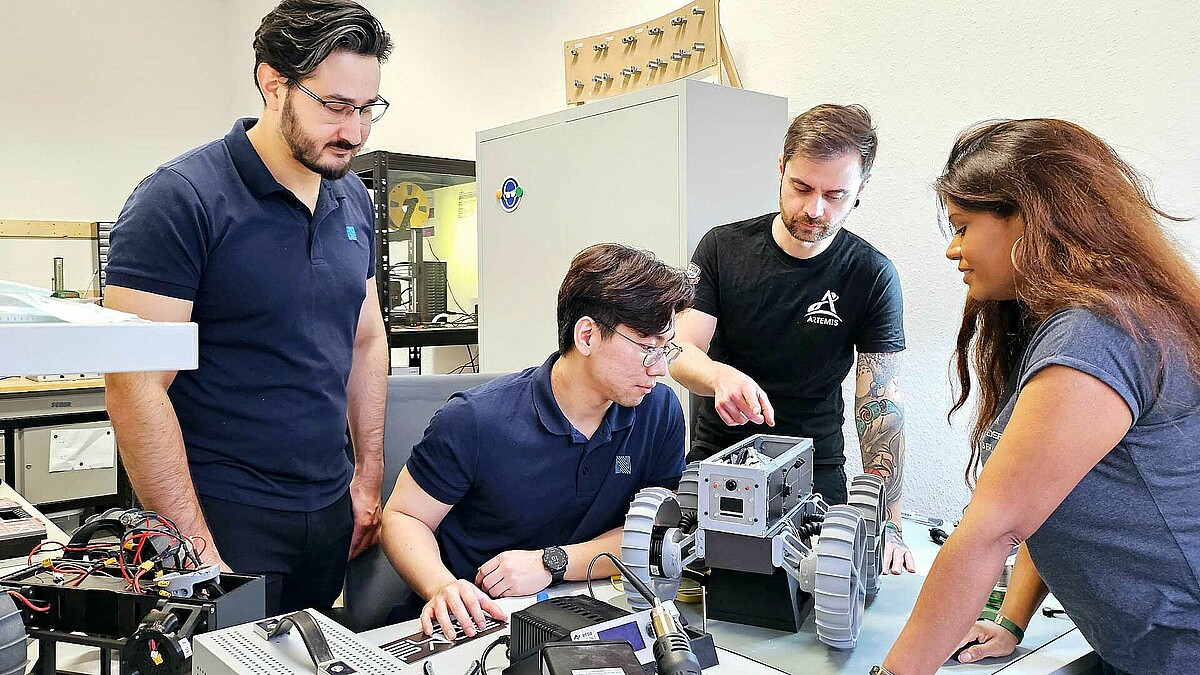
NEUROSPACE is developing modular lunar rovers based on the CubeSat standard and has been selected by NASA to participate in the Artemis 2 mission, the first crewed lunar mission since Apollo 17, providing a genuine taste of Berlin’s ambitions beyond Earth orbit. At the heart of NEUROSPACE’s work is the HiveR platform, named after the beehive and designed for swarm operation. The platform combines a HiveR Queen, a larger rover that handles communication, energy management and coordination, with smaller specialized units: HiveR Drones equipped with optical systems, spectrometers and LiDAR sensors for mapping and exploration, and HiveR Workers fitted with robotic arms for sampling, maintenance and supporting other rovers. The vision is a complete chain from exploration to logistics on the lunar surface.
Seqana uses satellite imagery and machine learning to deliver scientifically rigorous carbon monitoring solutions for soil-based projects globally, helping corporations and project developers measure environmental impact at scale. AIRMO, with seed funding secured in 2025, is preparing to launch the world’s most advanced greenhouse gas monitoring satellite from Berlin in 2027. MO-SPACE is developing complete quantum key distribution payloads for satellite-based secure communications. BERLIN SPACE specializes in Hall-effect electric thrusters and integrated propulsion systems for spacecraft. Space Structures has delivered over 500 structural projects for space applications since 2011, covering primary satellite structures, opto-mechanical systems, solar array structures and International Space Station experiments.
The broader ecosystem also includes established aerospace players: Airbus Defense and Space operates a site in nearby Potsdam, and Belgian aerospace group SONACA is represented in Adlershof through Sonaca Space GmbH. ICEYE, the Finnish SAR satellite specialist, founded a German subsidiary in the summer of 2026 that will operate an AI center in Berlin.Taken together, Berlin covers the full value chain from components to constellations to data platforms.
Berlin also hosts the ILA (the Innovation and Leadership in Aerospace exhibition, one of the world's oldest and most prestigious aerospace trade shows, held every two years at Berlin Brandenburg Airport). The ILA is one of the highest-revenue aerospace events globally and brings together industry leaders, researchers and policymakers in a format that makes Berlin a natural meeting point for the international aerospace community.
For the past 30 years, Berlin has been the chosen location for the internationally recognized IAA Symposium on Small Satellites for Earth Observation, with more than 300 participants.
The Power of the Ecosystem
Perhaps Berlin's greatest asset is the quality of collaboration within its space ecosystem. The tight network connecting startups, established companies, universities, DLR research institutes and federal agencies creates a multiplier effect: breakthroughs in photonics feed into new satellite payloads; AI talent from the tech scene finds its way into Earth observation platforms; manufacturing know-how from one company accelerates production timelines at another. The Berlin-Brandenburg Aerospace Alliance (BBAA) plays an important role in coordinating this network and connecting regional players with international partners and programs.
This interconnected ecosystem, backed now by unprecedented public investment and a Europe-wide push for sovereign space capabilities, makes Berlin one of the most compelling locations in the world for companies looking to build, test, scale and commercialize space technology. The market ramp-up is happening now. The infrastructure is being built. The talent is here. And the partnerships are ready to be made.
For international companies and startups looking to establish or expand a European presence in the New Space sector, there is genuinely no better place to start than Berlin.
Want to explore Berlin's New Space ecosystem?
Berlin Partner for Business and Technology offers free, hands-on consulting services for companies considering a move to or expansion within Berlin. Whether you need market intelligence, partner introductions, support navigating funding programs, or guidance on setting up operations, the team is ready to help. Marielies Becker and Magdalena Zawodny-Barabanow from the Aerospace & Space team at Berlin Partner are your first port of call. Reach out directly and start your journey into Europe's most exciting space ecosystem.